 Buying
Financial Help for First-Time Home Buyers in Canada
Saving for a home in Canada can feel like trying to hit a moving target. While saving up a down payment is usually the single biggest obstacle for first-time buyers, you don't have to carry the entire financial load completely on your own.
Federal and provincial governments offer a suite of tax incentives, savings accounts, and rebate programs designed to ease the upfront burden. When combined strategically, these programs can significantly shorten your timeline to homeownership.
Here is a breakdown of the key financial programs available and how to make the most of them.
- The First Home Savings Account (FHSA)
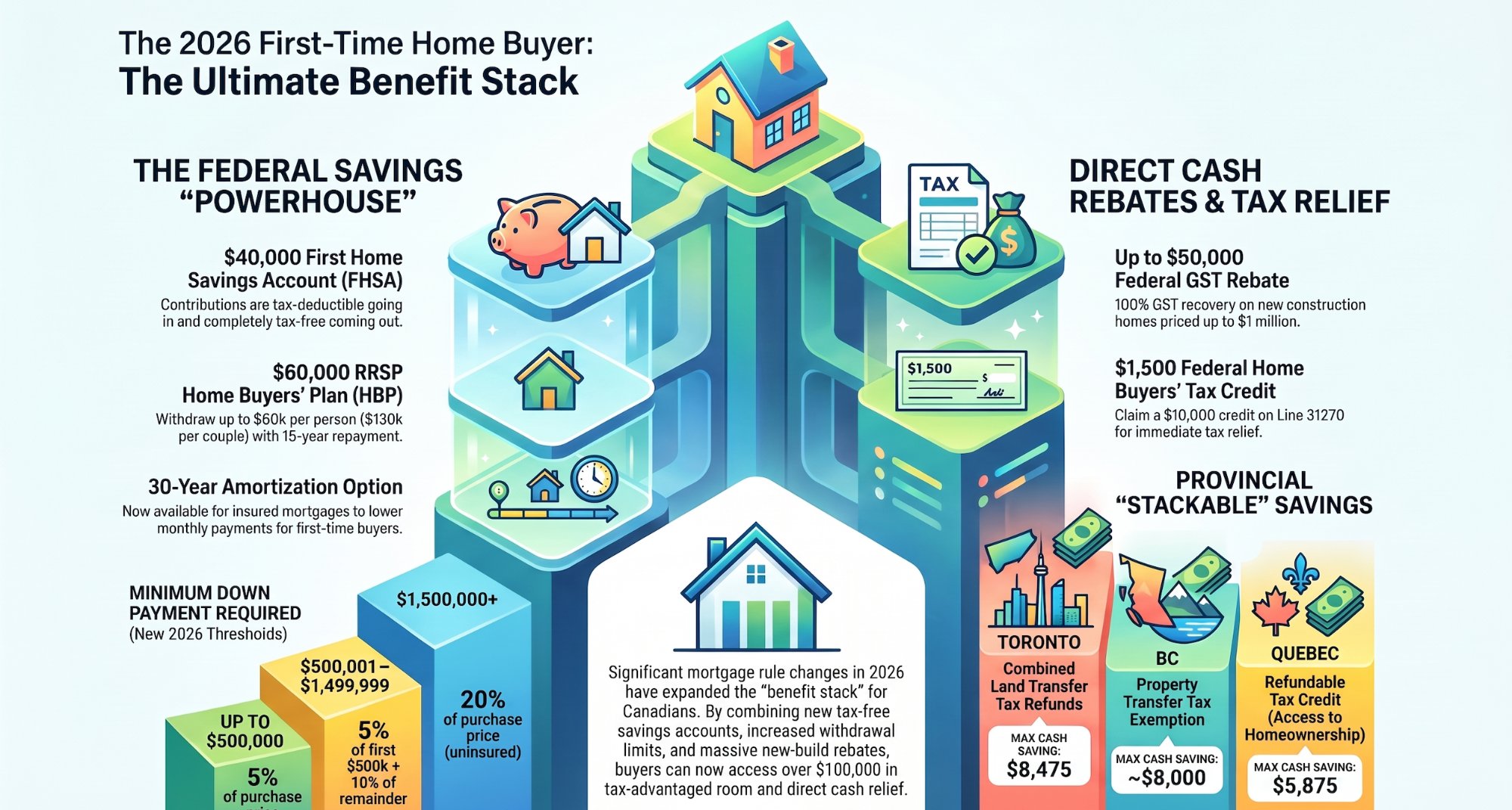
If you haven't opened an FHSA yet, it should be high on your priority list. Introduced as a hybrid between an RRSP and a TFSA, it gives first-time buyers the ultimate tax advantage:
- Tax-Deductible Contributions: Money you deposit reduces your taxable income for the year (like an RRSP).
- Tax-Free Withdrawals: As long as the funds go toward buying your first home, you won't pay a single cent of tax when taking the money out (like a TFSA).
- Annual Limits: You can contribute up to $8,000 per year, up to a lifetime ceiling of $40,000.
- The RRSP Home Buyers' Plan (HBP)
The Home Buyers' Plan allows you to borrow funds from your Registered Retirement Savings Plan (RRSP) tax-free to put toward your purchase:
- You can withdraw up to $60,000 tax-free from your RRSP.
- If you are buying with a partner who is also a first-time homebuyer, you can pool your limits together for up to $120,000.
- You have 15 years to pay the withdrawn funds back into your RRSP, with repayments usually starting two years after the initial withdrawal.
Pro Tip: You can stack the FHSA and the HBP together on the same home purchase.
- The First-Time Home Buyers' Tax Credit (HBTC)
When you complete your tax return for the year you purchase your home, don't forget to claim the HBTC:
- This program grants a non-refundable tax credit of up to $10,000 on eligible home purchases.
- In real terms, it translates to up to $1,500 in direct tax relief—a welcome cushion to help offset immediate legal fees, moving costs, or land transfer taxes.
- GST/HST New Housing Rebate
If you are purchasing a newly built home or buying land to construct a property, you may qualify for a partial rebate on the GST or HST paid during closing.
- The rebate is designed to reduce the tax burden on new construction and substantial home renovations.
- Eligibility depends on the final purchase price of the home and whether it will serve as your primary residence.
Down Payment Essentials: How Much Do You Actually Need?
Understanding minimum down payment tiers in Canada helps you set a realistic savings target: Purchase Price Range Minimum Down Payment Required $500,000 or less 5% of the purchase price $500,000 to $1,500,000 5% on the first $500,000 + 10% on the remaining balance Over $1,500,000 20% flat minimum
Note on Mortgage Default Insurance: If your down payment is less than 20%, you will need mortgage default insurance (often called CMHC insurance). While this adds a small percentage (0.6% to 4.5%) to your total mortgage amount, it enables you to enter the housing market much sooner with a smaller upfront deposit.
The Smart Strategy: Stack Your Benefits
Buying a home isn't just about accumulating a single pile of savings—it's about leveraging these tools together. By pairing tax-free FHSA growth with an RRSP HBP withdrawal and claiming tax credits at year-end, you can noticeably reduce your out-of-pocket costs.
Before you start touring homes, get pre-approved for a mortgage. Knowing your upper limit and having your down payment strategy organized gives you the confidence to act quickly when the right property comes along.